Look Inside
Check and search what's really in your files and objects instead of guessing from filenames, with built-in patterns and customer-defined labels.
Pulse gives your team one spot to view and search sensitive files and objects, risky movement, lineage, and audit evidence without sending the work to a separate analytics stack.
Use Pulse when the question is not just "did the file move?" but "what was it, who touched it, which policy applied, and can we prove it later?"
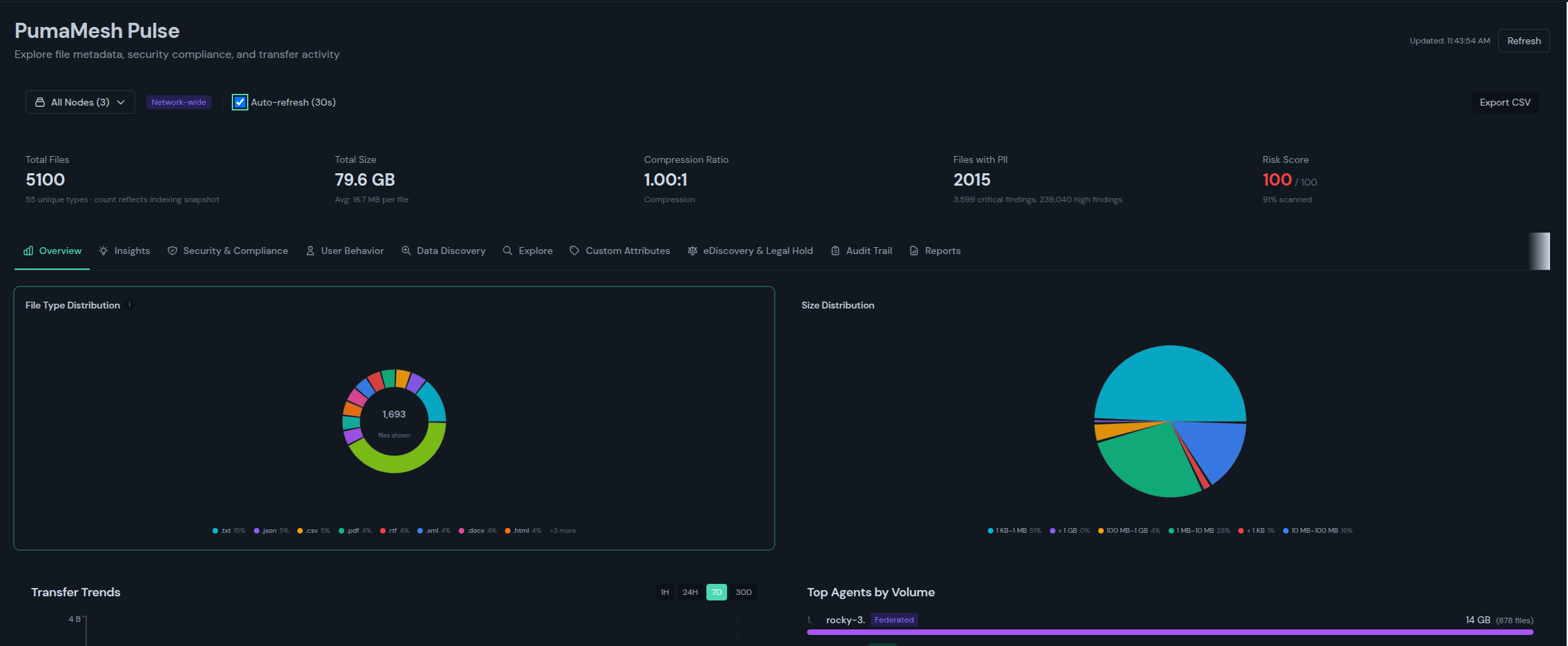
Pulse keeps discovery, policy, movement, and evidence connected. The first job is clarity: show sensitive data, risky movement, and audit proof in the same place operators already work.
Check and search what's really in your files and objects instead of guessing from filenames, with built-in patterns and customer-defined labels.
Connect findings to the compliance and AI governance frameworks buyers already need to explain.
Use content and user context to decide who can see, move, or act on data.
Turn findings into action and proof without exporting everything into a separate reporting project.
Pulse is not just "discover and classify." It is a repeatable workflow: find exposure, rank risk, assign owners, fix it, and prove closure with exportable evidence.
Find Exposure
Start from sensitive data and operational contextSee findings, classifications, storage spread, exposure signals, and movement context across every node.
Rank Risk
Prioritize what actually mattersRisk score, anomaly views, confidence levels, and framework-mapped reports keep teams on the most urgent problems first.
Prove Closure
Keep evidence attached to the workflowAudit-ready reports, chain-of-custody, exportable artifacts, and case workflows make the response easy to review later.
Pulse gives teams ready-made views, reports, sensitive-data patterns, and rich file context across the mesh without forcing a central collection project.
11 views
One place for posture and evidenceOperators can move from overview to discovery, audit, reporting, legal hold, and AI insights without changing tools.
15 report sources
Reports from work the platform already seesBuild reports from findings, transfers, policy events, storage context, and other movement evidence.
120+ patterns
Find sensitive data across the fabricIdentify PII, PHI, financial, credential, and cryptographic data before teams move, share, or escalate it.
10,000 attributes
Rich context per fileFile context supports policy, reporting, search, and forensic review across the fabric.
Federated queries
Ask questions across the meshViews can reach local nodes, all peers, or a scoped set without a separate collector project.
6 visualizations
Move from summary to evidence fastTables, charts, metric cards, treemaps, and heat maps help teams explain posture and movement quickly.
Pulse maps to the posture language buyers already know — discovery, exposure, classification, anomaly, compliance, remediation — then extends it into motion and AI. And because it lives inside the fabric that moves the data, findings are immediately actionable.
Discovery
See sensitive data, exposure, and category contextKnow what the data is, where it sits, and which findings matter — before you move, restrict, or escalate it.
Insights
Coverage, confidence, and improvement over timeTrend and confidence views make posture work measurable instead of anecdotal.
DSPM Fit
Maps cleanly to the posture language buyers knowSix posture categories familiar to any DSPM evaluator — extended into transfers and AI pipelines, federated by default.
Investigation Fit
Pulse leads with evidenceTimeline, source-linked findings, identity and activity context, and exportable reports make Pulse credible for early-stage investigation.
Differentiator
Analytics tied to movement and policyOne data model for transfer, posture, and audit — findings drive policy, not just dashboards, and are actionable in the same console.
Programmatic Access
Scoped API tokens with expiry and revocationReach Pulse data and collection workflows through scoped, revocable tokens — so reporting automates cleanly into your existing tools.
Case lifecycle, legal hold, collection search, and chain-of-custody are built in — integrated workflows inside the fabric, not a replacement for a full downstream review suite.
Legal Hold
Preserve data in place, across the meshPlace holds on files wherever they live — portals, agents, or other mesh nodes — without moving the data first.
Collection Search
Find responsive data across the fabricFederated search with classification, attribute, and custody filters — scoped to the matter at hand.
Chain of Custody
Exportable evidence with provenanceEvery action is logged. Every artifact carries its custody record. Reports export in formats counsel and regulators accept.
Every major AI platform ships its own controls. Pulse helps connect the path when sensitive data leaves storage, moves through PumaMesh, lands in a model workflow, and shows up in retrieval, fine-tune, or agent activity.
Prompt + Retrieval Lineage
Know which sensitive records shaped a responseConnect AI outputs back to their source data — so teams can see which sensitive records entered retrieval, fine-tune, or agent activity across platform boundaries.
Fine-Tune Leakage
See which sensitive data entered which modelTraining set posture, fine-tune provenance, and model lineage give teams the governance view that AI platforms don't provide on their own.
Agent Access Policy
Control what AI agents can reachThe same data context that gates file movement also limits what AI agents are allowed to read, write, or act on — so policy extends into agentic workflows.
Pulse helps teams see exposure faster, connect identity and activity, prioritize fixes, govern AI pipelines, and produce audit-ready evidence — all from one federated layer.
DSPM
Discovery, exposure, posture, and risk reportingMaps cleanly to the language of any enterprise data security posture evaluation — then extends it into motion and AI pipelines.
DSPM for AI
Federated lineage across AI platformsThe white space no AI platform vendor owns: one neutral posture view across Bedrock, Foundry, Vertex, Databricks, Snowflake, and the data feeding them.
eDiscovery
Legal hold, collection, chain of custody, and reportingIntegrated investigation workflows inside the platform — not a replacement for a full downstream review suite.