Built for AI

AI needs secure data movement that teams can actually operate.

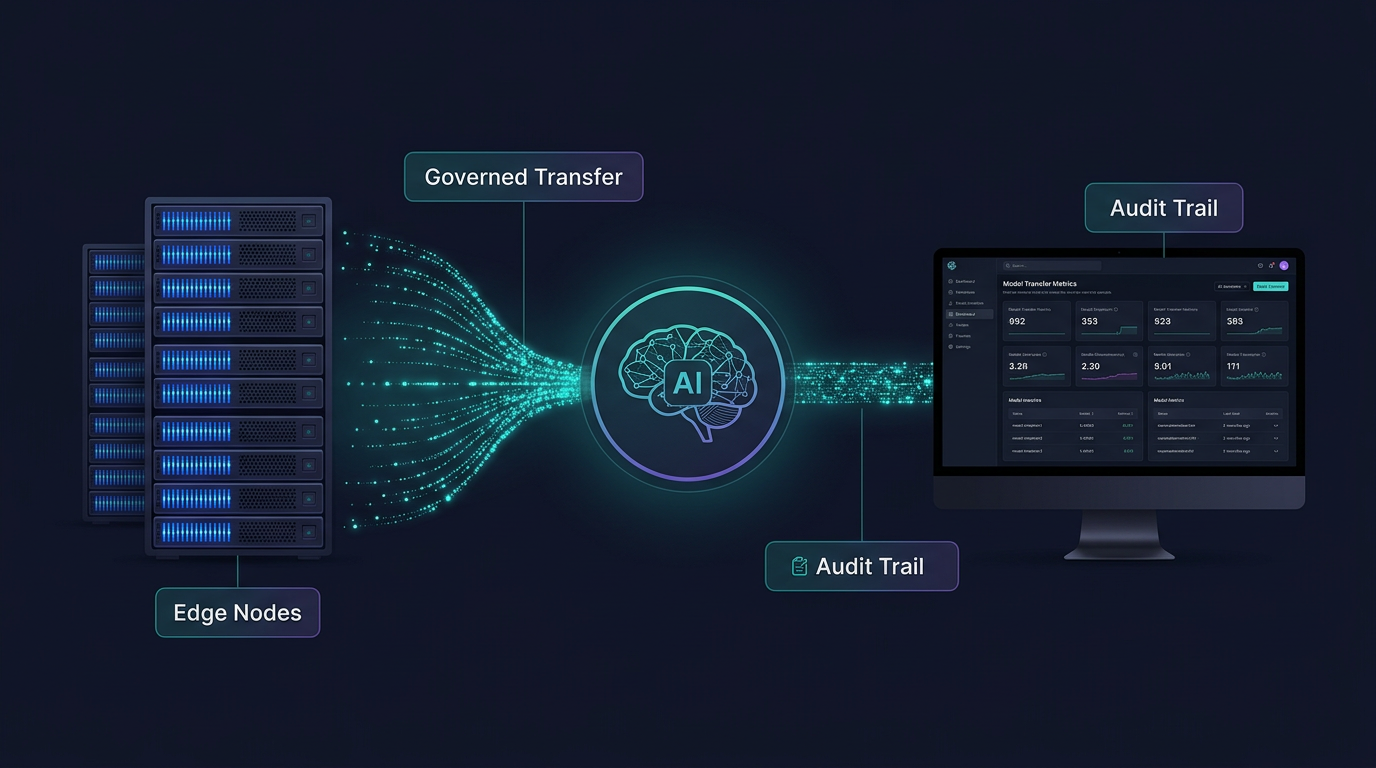
PumaMesh helps AI teams move models, weights, training data, retrieval data, and results without splitting delivery, security, lineage, and audit across separate tools.

It brings the same simple PumaMesh story to AI: protect important data, understand what it is, move it where it is allowed to go, and accelerate access when speed matters.

AI delivery models, weights, and data Crypto runtime wolfSSL 5.9.1 Governance policy and audit stay attached Speed 25.8 Gbps benchmark proof
Windows + Linux, Natively

One policy model from the laptop to the GPU cluster.

AI work often starts on Windows and runs on Linux. PumaMesh supports both so data stays governed from export through training, delivery, and reuse.

  • Native Windows and Linux Agents with the same policy surface
  • Works across cloud AI platforms, on-prem GPU clusters, and edge environments
  • wolfSSL-based encryption protects data in flight and at rest
  • No SDK integration required; applications keep working unchanged
Three flows, one fabric

Three AI flows, one fabric.

A training pipeline is machine to machine. A RAG response is machine to person. Research collaboration is person to person. PumaMesh runs all three with the same policy and evidence model.

Machine → Machine

AI pipelines at line rate

Model delivery, training-set replication, fine-tune pushes, inference-cache sync, agent-to-agent tool-calls — all policy-gated and post-quantum-encrypted on every hop.

  • Llama 3.3 70B (~140 GB) in under 60 seconds cross-Pacific
  • OpenAI-class 120B (~240 GB) in under 90 seconds
  • Falcon 180B (~360 GB) in under 2.5 minutes
  • Federated learning with encrypted gradient flow across sovereignty zones
Machine → Person

AI outputs delivered with source lineage

RAG responses, model outputs, findings, and reports reach humans with the classification and provenance of the underlying records intact. ABAC decides who can see what before the response renders.

  • Retrieval lineage links every response to source-row sensitivity
  • Per-file ABAC re-evaluated on delivery (continuous authorization, 300s freshness)
  • Operator dashboards show exactly what the model saw, from where, under which policy
Person → Person

Collaboration on AI training data without leaking it

Partner exchange, cross-institution research, and legal/IP sharing move between people and organizations with the object carrying its own rules — the sender's permission doesn't override the recipient's restrictions.

  • Training data shared across partners under per-file ABAC, not per-bucket grants
  • PHI/PII stripped or quarantined before any hop if policy requires
  • Chain-of-custody evidence attached to the transfer, exportable for IRB, legal, or compliance review
AI control surfaces

Governance that follows data into the model, not just into the bucket

Classical DSPM stops at the bucket. AI broke that assumption. PumaMesh enforces policy at the points that actually matter for AI — training, retrieval, tool-calls, and fine-tunes — and produces the evidence regulators now require.

Training Boundary

Restricted records can't enter a fine-tune that leaves the sovereignty zone

ABAC on classification, jurisdiction, and customer ontology gates which records can enter which training artifact — before bytes leave the source.

Retrieval Boundary

PHI doesn't cross into non-US-hosted model context

RAG retrievals evaluate ABAC per-record before embedding or inference. Fresh within 300 seconds, fail-closed on revocation.

Tool-Call Boundary

Agents can only invoke tools their attributes allow

The same ABAC surface that gates file movement gates what an AI agent can read, write, or act on — one policy language, one enforcement point.

Fine-Tune Provenance

See which sensitive records entered which model

Training set posture, fine-tune lineage, and model-to-source mapping — the governance layer MLOps platforms still don't own.

Evidence for the AI era

Controls mapped to the frameworks AI buyers and regulators now demand

Every transfer produces audit evidence aligned to the standards governing AI today — not just the ones that governed file transfer a decade ago.

EU AI Act — Article 12

Automatic activity logs with operator, classification, policy, and model-lineage context — exportable for the record-keeping obligations governing high-risk AI systems.

NIST AI RMF

Measure and Manage functions (MS-1 to MS-4, MG-1 to MG-4) supported with training-set posture, fine-tune provenance, and retrieval lineage reporting.

ISO/IEC 42001

AI management system evidence — data governance, lifecycle controls, and model-to-source traceability in the same audit chain that produces CMMC and FedRAMP evidence.

CMMC v1, v2, and v3

All 110 CMMC controls met for data sharing. NIST SP 800-171 Rev 2 and Rev 3 anchor requirements satisfied by the product. AI training data inherits the same CUI control surface as any other regulated record.

FedRAMP-Aligned Controls

80+ NIST SP 800-53 Rev 5 controls mapped with direct code evidence. AI pipeline boundaries inherit the same enforcement and audit.

Cyber insurance & model risk

AI data surface inventory, sensitive-data flow map, and training provenance — the artifacts underwriters and internal MRM teams now ask for on every renewal.

Get Started

Put one fabric between your data and every AI pipeline that touches it