Protect
Secure your data
Replace fragmented MFT stacks with one governed movement fabric that handles files and objects — streaming, caching, searching, and moving fast, with post-quantum security and audit evidence built in.
Use it across partners, cloud, edge, AI pipelines, and regulated environments without stitching together separate tools for movement, protection, visibility, and audit.
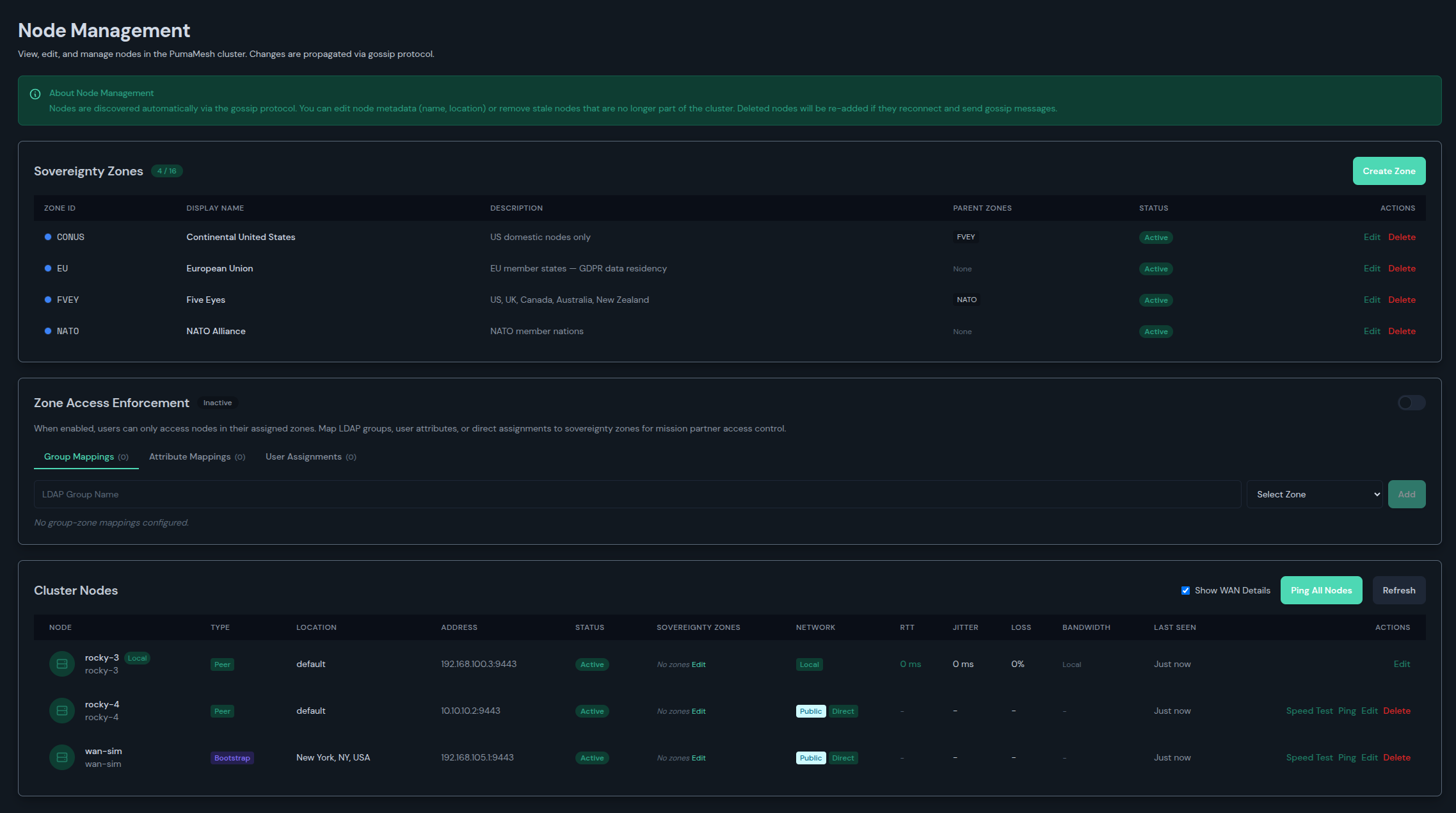
PumaMesh gives teams one operating model for the full job: protect important data, understand what it is, move it where it belongs, and make the result easier to prove.
Secure your data
Know what's in files and objects
Stream and move it smoothly
Get results faster with caching and search
The same platform helps security, platform, compliance, and partner teams reduce transfer risk without creating separate ownership models.
CISO · Security Leadership
Reduce transfer risk and audit fatigue by handling large files and objects with streaming and caching, not just moving them.Pain: Legacy transfer stacks keep adding patches, compensating controls, and one-off evidence projects.
Outcome: PumaMesh keeps protection, governed movement, and audit evidence in the same workflow.
Platform · AI Engineering Lead
Move modern payloads without new exception paths by handling large files and objects with streaming and caching, not just moving them.Pain: Large models, datasets, and software artifacts now move across mixed Windows, Linux, cloud, and edge estates.
Outcome: PumaMesh lets teams keep familiar workflows while movement, policy, and proof stay consistent.
Compliance Officer · Program Manager
Make reviews easier to support by handling large files and objects with streaming and caching, not just moving them.Pain: Each framework asks for evidence, but legacy stacks produce separate audit trails that must be reconciled later.
Outcome: Evidence is created as data moves, giving reviewers a clearer path from action to proof.
Partners · System Integrators
Accelerate client value with a modern fabric by handling large files and objects with streaming and caching, not just moving them.Pain: Integrating disparate MFT and security tools into client environments is slow and high-maintenance.
Outcome: API-first, zero-trust architecture makes PumaMesh the ideal component for modernizing client data pipelines.
Start with the systems that create, store, or use important data. PumaMesh adds a shared policy and visibility model, then lets each environment use the cleanest governed path available.
Portal · Linux
Coordinate policy and visibilityThe Portal gives operators a common view of policy, system health, and movement history across the environment.
If the Portal is unreachable, approved peers keep moving data under the last known policy and reconcile when connectivity returns.
Agent · Linux & Windows
Bring governance to the sourceAgents run on the systems where data is created, captured, processed, or shared.
That lets teams protect and move data from the source instead of waiting for it to reach a central tool or staging area.
Applications and users keep working in familiar paths while PumaMesh keeps protection, access decisions, and evidence in the movement path. See how the mesh moves data →
Post-Quantum Encryption · wolfSSL
Protection that does not require app rewriteswolfSSL provides the post-quantum cryptographic layer — built for constrained environments and hardened against future threats. Users and applications keep working through normal paths while the fabric encrypts data at rest and in motion.
Shield + Audit
Security evidence stays with the workOperator actions, movement history, and protection context are recorded with the transfer instead of reconstructed later.
ABAC
File context drives accessClassifications, findings, and customer-defined labels help decide who can see data, where it can move, and when a request should stop.
Policy Detail
One policy surface, many decisionsThe same context that helps teams find and report on data can also guide movement, visibility, and delivery decisions.
See exactly what files and objects you're handling before they go, so rules stay in place for streaming, caching, and searching.
Find
Find data across distributed environmentsOperators can search local and remote systems, filter by sensitivity, and act with the right context.
Classification
Make important data legibleBuilt-in patterns and customer labels help teams understand what a file contains before it moves.
Metadata
Use context for action, not just dashboardsMetadata supports policy, search, audit, and reporting without sending teams to separate tools.
Whether it's computer-to-computer, system-to-person, or sharing with partners, everything follows the same rules for files, objects, streaming, and caching...
Speed
Move large payloads across distanceLarge files, datasets, and model artifacts can move quickly across long-haul and constrained paths.
Goodput · QUIC
Keep work moving on imperfect networksQUIC's built-in congestion control and connection resilience keep transfers productive on high-latency, degraded, or intermittent paths — where TCP stalls.
Adaptive Routing · Route-Thru
The fabric finds the best authorized path automaticallyPumaMesh senses enrollment state and attribute context to build a live route table, then adaptively routes data to its destination by the cleanest available path — routing thru authorized intermediaries and re-routing when topology changes — without static VPN configuration.
Zones Extend ABAC
Respect geography and trust boundariesSovereignty and environment rules help keep sensitive data in the places it is allowed to live.
Parallel Streams · QUIC
Use all available bandwidth, not just one pipeQUIC multiplexed streams let the fabric saturate available capacity across distance. When one stream degrades, others continue — which is what the benchmark numbers are built on.
Operator Visibility
Show operators what happenedEvery transfer carries useful context: what moved, where it went, how it performed, and which controls applied.
Help your team stream, cache, and search for data faster with clear proof, so decisions happen quickly and safely.
Time to Access
Find authorized data where it livesTeams can locate data across the mesh without waiting for a central staging copy or separate collection project.
Time to Insight
Context is ready when the data landsClassification, findings, and attributes travel with the work so teams can act sooner.
Time to Decision
Evidence is created as work happensAudit and lineage are produced during movement, making reviews and investigations easier to support later.