Operating Model
Legacy stacks split the work across ownersTransfer, acceleration, encryption, posture, and evidence often live in different products with different operating teams.
PumaMesh gives buyers a cleaner replacement path from GoAnywhere, MOVEit, IBM Aspera, and Cleo FileCatalyst: lower transfer risk, less tool sprawl, predictable movement costs, and governed delivery for AI, partner, cloud, edge, and regulated workflows.
The technical proof is still here, but the buyer question is simple: can your transfer platform keep data secure, fast, governed, and explainable — without the breach history of legacy MFT vendors?
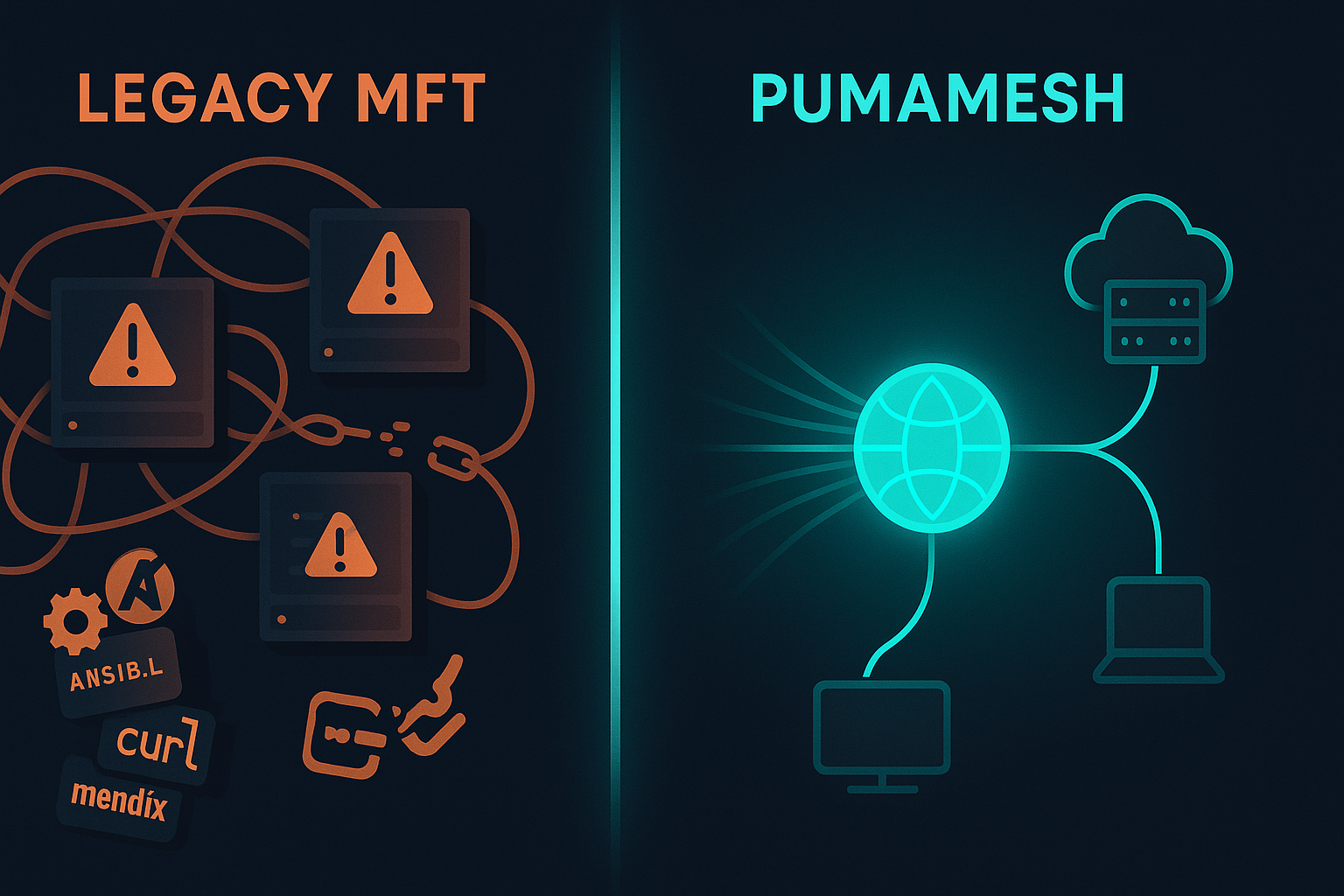
The decision is no longer just "can it transfer a file?" Buyers compare operating simplicity, security, speed, predictable cost, and proof across the whole data path.
Operating Model
Legacy stacks split the work across ownersTransfer, acceleration, encryption, posture, and evidence often live in different products with different operating teams.
Security Model
Modern movement needs data-aware controlThe platform should understand what is moving, not only which connection carried it.
Proof Model
Audit should come from the work itselfBuyers need movement records that already include policy, operator, classification, and delivery context.
Patching matters, but it does not fix a transfer program built around separate tools, brittle exception paths, and evidence that has to be reconciled after the fact. PumaMesh changes the operating model.
Attack Surface
Smaller transfer footprintFewer components and fewer add-ons mean fewer things to patch, monitor, and explain during security review.
Supply Chain
Clearer software assuranceSecurity teams need to know what is running, where it is deployed, and how it is maintained.
Transport · QUIC
A movement layer built for distance and scaleQUIC parallel streams use the available link instead of serializing through one TCP connection. Legacy MFT was designed when WAN acceleration was a separate SKU — QUIC makes it the default. See the Mesh →
Policy
Policy tied to the dataData context helps decide who can use a file and where it can go, even across partner and cross-boundary workflows.
PumaMesh fits around the systems and users already moving data. Teams can modernize one flow at a time while keeping familiar workflows intact.
1 · Drop in
Start alongside existing transfer flowsBegin with a controlled workflow and prove movement, protection, visibility, and audit in your own environment.
2 · Cut over
Shift one movement pattern at a timeMove system pipelines, reports, or partner exchanges in phases so each cutover creates its own proof trail.
3 · Decommission
Reduce the tools left behindAs flows move to PumaMesh, teams can reduce duplicate transfer, acceleration, posture, and evidence tooling.